Every other label on this site has to last until something is sold, used or
despatched. An asset label has to still be readable at an audit nobody has scheduled yet,
on a thing that has been moved, cleaned, sat on and forgotten for twenty years.
That is a different job, so it is a different
label — different material, different adhesive, and a number that belongs to your
register rather than to a product.
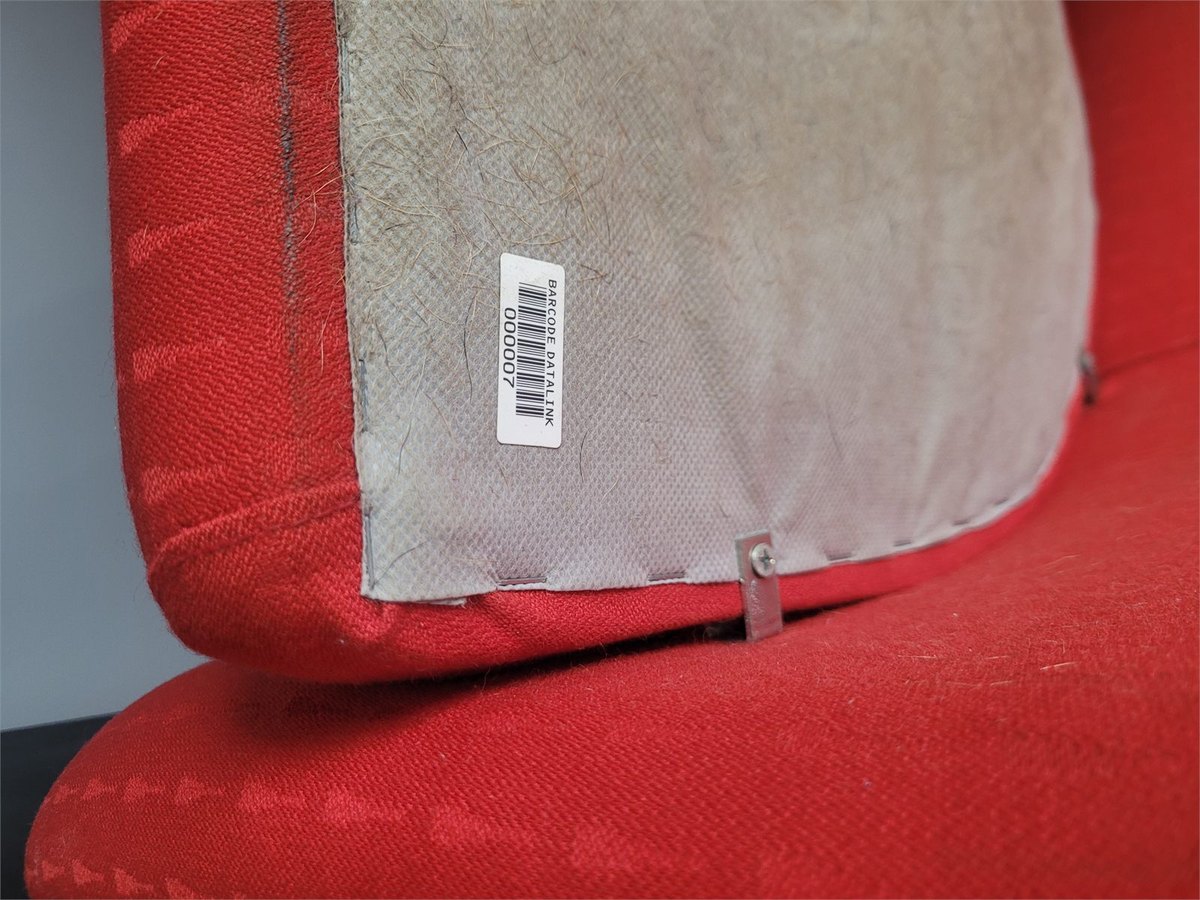
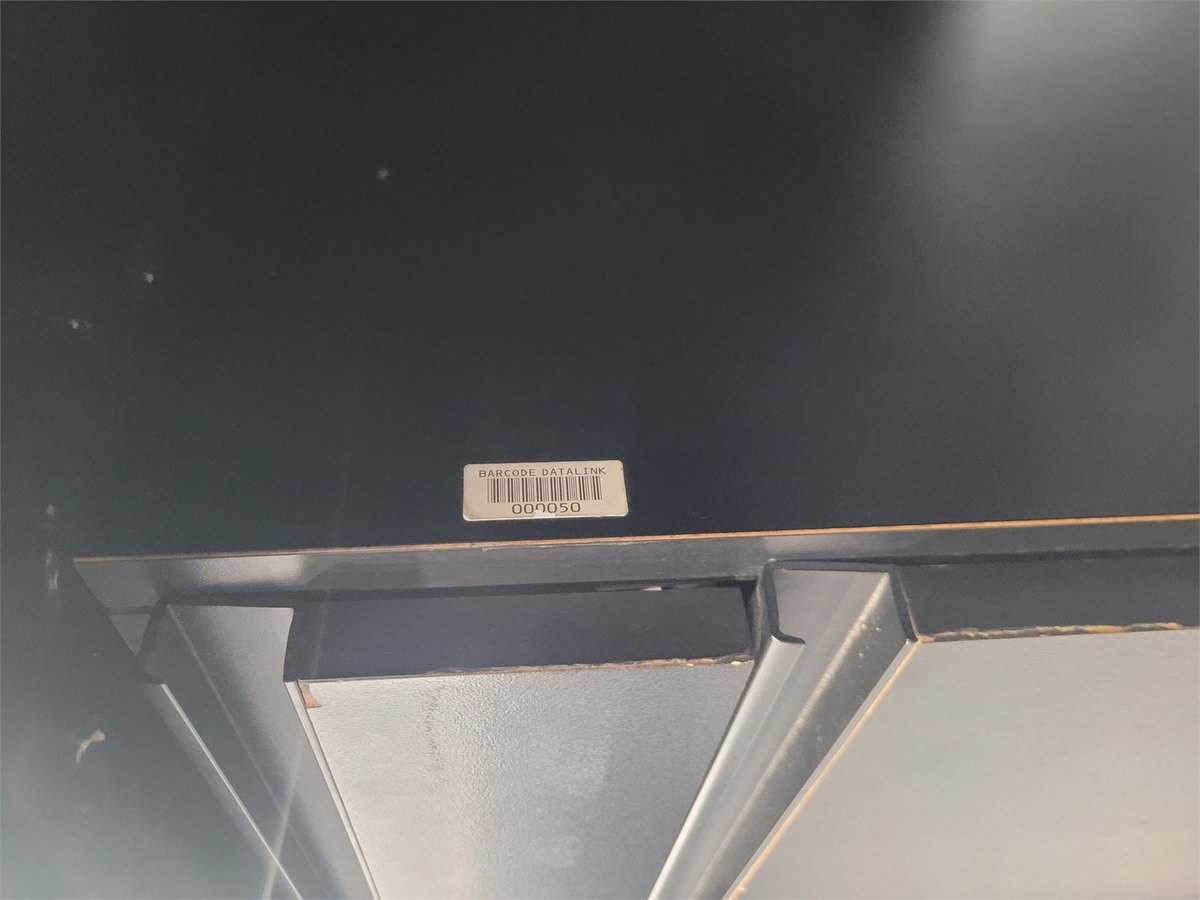
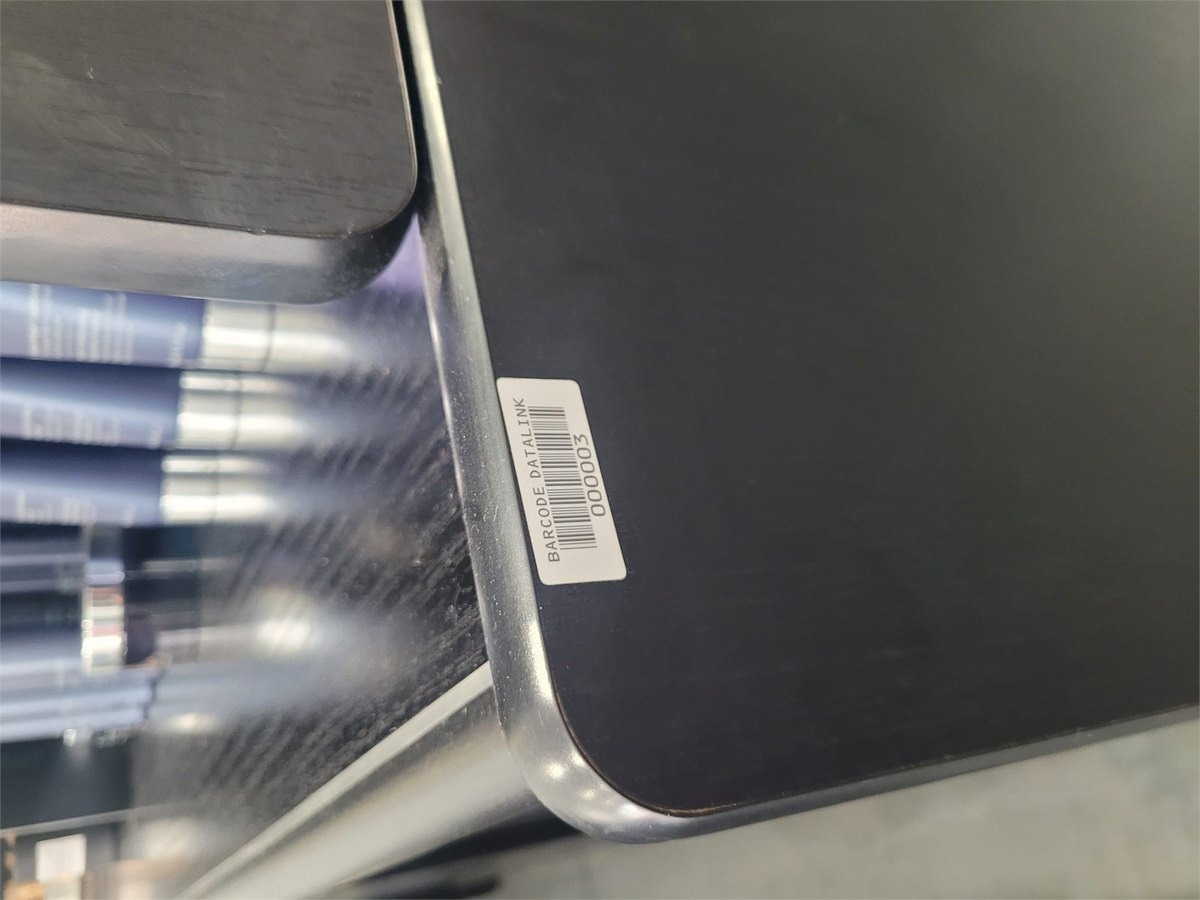
Photographed August 2026 · applied 1996
These went on twenty-nine years ago.
Not a demonstration and not somebody else's case study. This is our
own office furniture, labelled when we set up the asset register, and photographed last
week exactly as it sits. They are plastic asset labels — the second of the four
manufactured options below, not the dearest.
Asset 000007, on the back of a chair somebody has sat in every
working day since. The barcode is still crisp enough to scan
first time.Asset 009050, under a desk. Wiped, knocked and vacuumed around for
three decades. The print has not lifted and the edges have not
curled.Asset 000003, on a display cabinet — one of the first three
things we ever numbered. A paper label in that position would have been unreadable by
about 2001.
That is the entire argument for this page. Anybody can tell you a label is
durable. Nobody else can show you theirs after twenty-nine years, because most of them
were not selling labels in 1996.
The company that manufactured these has been bought by a
multinational since. We are still answering the same phone number.
Two ways to get one
How hard a life does it have?
That is the only question, and it decides the material rather than
the design. All of these take a barcode and a number. They differ in what they survive
and what they cost.
The cheap way first, because sometimes it is the right one. We can overprint
poly or silver mylar here in Berowra on our own
ZM400, the same way we do
pre-printed labels — your numbers, your
company name, a box in the post. It is the least expensive numbered asset label there
is and it suits a small register, a quick start, or assets that will be replaced before
the label is really tested.
For serious asset tracking we recommend the manufactured
labels below, every time. Not because ours are bad, but because a printed image sits
on the surface and these do not — and an asset register is a thing you build once
and live with for twenty years.
01 · manufactured
Standard
Indoors. Office furniture, general equipment, anything living under a roof and
handled by people rather than machinery. The image sits under an over-laminate
that takes the wear instead of the print.
The entry point, and enough for most offices — though
the ones in the photographs above went a step up to plastic.
02 · manufactured
Plastic
Indoors, but on surfaces that fight back — textured plastic, powder coat, an
awkward curve — or where the asset gets water and mild detergent on it now and
then.
A polyester base under an over-laminate, with a
far more aggressive adhesive: high initial tack, UV resistant, and made to
keep holding as it ages rather than letting go in year three.
03 · manufactured
Aluminium foil
Indoors or outdoors, and the one that goes on curved or flat surfaces alike
— which is why it is the most widely used of all of them. It conforms to a
pipe, a casting or a motor housing without lifting at the edges.
Withstands chemicals, abrasion, solvents and high
temperatures, and this is the one that starts to look permanent rather than
applied.
04 · manufactured
Rigid aluminium
Indoors or outdoors, flat surfaces only, and the hardest life a label can be
asked to have. Thicker and stiffer than foil, with a high tack adhesive, for plant
and equipment that lives outside and gets pressure washed.
If foil will conform to the surface, foil is usually the
answer. This is for when it will not, and for when nothing is allowed to
fail.
How long the manufactured ones take.Four to five weeks for aluminium or
foil, and the clock starts after the artwork is approved rather than when you
order — so the sooner the numbers and the layout are settled, the sooner it
starts. They are made overseas and there is no version of that which is quick.
In practice this has never been a problem, and the reason is
worth saying out loud: nobody rings up needing aluminium asset labels tomorrow.
An asset register is something you plan, not something you react to. And if you genuinely
are in a hurry, the overprinted poly and mylar above go out in days rather than weeks
— which is a real reason to choose them, not just a cheaper one.
Sizes differ by material, so pick the material first. Each family has its
own list, and they do not line up with each other — which matters more than it
sounds.
Material
Sizes
Smallest
Largest
Standard
7
30 × 10
44 × 24
Plastic
6
30 × 6
55 × 25
Aluminium foil
9
32 × 10
64 × 38
Rigid aluminium
10
30 × 11
64 × 38
The two aluminium families share seven sizes, so moving
between foil and rigid later is easy. The two indoor materials share almost nothing with
them. So if there is any chance this register ends up on aluminium one day —
because the assets move outside, or the next site is a yard — choose a size that
exists there now, and the labels will still match in ten years.
And if none of the standard sizes suit,
there are over five hundred others on request. Worth knowing before anybody
redesigns a label to fit a list.
One thousand is the minimum, and they are sold in thousands. Below that the
setup costs more than the labels do, and nobody is served by it. The price per label
falls at 2,000, 5,000, 10,000 and 20,000.
Which is worth knowing if your register sits just under one of
those numbers. Order spares anyway — assets arrive, labels get applied to the
wrong thing, and a box of the right size sitting in a drawer is worth a great deal more
than a four-week wait for the next fifty.
Three details that only matter once the box arrives. The cartons and trays are
marked with the serial numbers inside them, so you can find 1000–1500
without opening four boxes. Orders come with cleaner and application
instructions, because surface preparation is most of whether a label is still there
in ten years. And some sizes have a break-away tab so the liner comes off
without a fingernail — which sounds trivial until you are on the four hundredth
one.
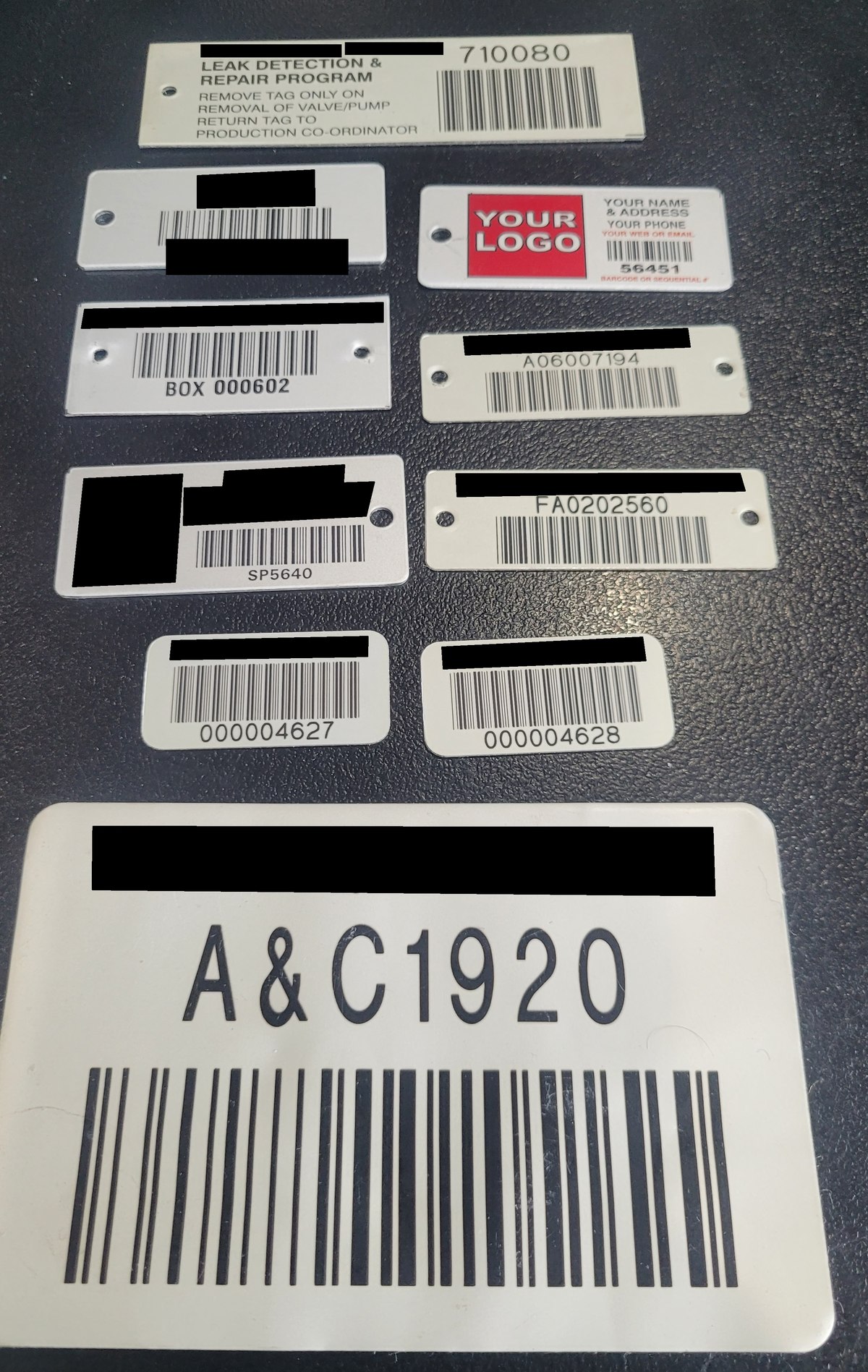
Samples collected over thirty-five years. The names are blacked out because
these are not our customers — they are examples of what the material does,
picked up along the way. What is worth looking at is everything else.
Tags or labels. The ones with holes are tags: no adhesive, wired or
screwed to the asset, for things you cannot stick to or that get too hot, too oily or
too rough for glue to hold. The rest are adhesive-backed labels and go straight
on. Most people want labels; the ones who need tags usually know already.
And the range. Ten of them, from a thumbnail to a postcard. Instruction text where
the tag has to tell somebody what to do — the top one says to remove it only when
the valve comes off, and to return it to the production co-ordinator. Every number
format anybody has asked for. And a consecutive pair, 000004627 and
000004628, which is what sequential numbering looks like when it arrives.
Why the aluminium ones last, in one sentence. The barcode is not printed onto
the metal — it is photographically reproduced and then sealed inside the
anodic layer of the aluminium itself. There is no ink on the surface to wear off
and no laminate to peel, which is why these read after decades outdoors when a printed
label would have gone chalky in a summer.
The numbers
Your range, running in order.
An asset label is only useful if its number means something in your register. So the
numbering is yours: a start number, a quantity, and every label comes out different and
in sequence — which is what the 000003, 000007 and 009050 in
the photographs above are.
Send a spreadsheet instead and we will print straight from it,
one row per label, if the numbers are not sequential or if each one carries a
description. Your company name goes on them the way ours does. If you are starting a
register from nothing, the honest advice is to start the numbers higher than you think
you need and leave gaps between categories — renumbering an asset register later
is a job nobody enjoys twice.
The printing works the same way as our
pre-printed labels: you send the numbers, we set it
up in BarTender, and a box arrives.
Before you order
Four things worth deciding first.
01
What it sticks to
Powder-coated steel, painted timber, rough plastic, an oily machine casting. The
surface decides the adhesive more than the material does, and a label that will not
stay on is worse than no label because the asset goes missing from the register
rather than obviously missing from the shelf.
02
How big it can be
Big enough to scan, small enough to fit. A laptop lid and a forklift take very
different labels, and the scanner has to read it from wherever a person can
comfortably stand — which on a large asset is further away than people
expect.
03
Does it need to be tamper evident?
The commonest way an asset register goes wrong is not a lost label. It is a label
that moved — somebody peels the tag off a dead monitor, sticks it on
the replacement so the count still balances, and from then on your register
describes an asset that is not there.
A void label cannot be moved quietly. Lift it and
the layers separate: the word VOID stays behind on the old asset and the label
itself is visibly wrecked. Nobody has to catch them doing it — the evidence
is there at the next audit, which is usually enough that it never happens.
Available on the aluminium foil labels in three sizes
— 32 × 10, 38 × 13 and
38 × 19. Worth it wherever assets are leased, insured, depreciated, or simply worth
enough that somebody might be tempted.
04
What reads them afterwards
An asset audit is a person walking around scanning things, so the label has to
suit the scanner as much as the asset. If that scanner does not exist yet, the
cordless ones are the usual answer and a
mobile computer is the answer for a large
site.
Starting a register from nothing?
That is the call worth making before you order labels rather than after. What you are
numbering, how many, and who scans them afterwards changes every one of those answers —
and we have been on the other end of that conversation since 1991.